About The Desert Tortoise Conservancy — Our Mission & Conservation Work
Our Mission at the Desert Tortoise Conservancy (TDTC)
The Desert Tortoise Conservancy is a proud member of the Coalition for a Balanced Environment (CBE), and is proud to be a Life Member of the California Turtle and Tortoise Club (CTTC), The Desert Tortoise Council (DTC), and the Desert Tortoise Preserve Committee (DTPC).
Our goal is to design, build, and operate a Desert Tortoise Awareness Center and Experience in the Palm Springs area — educating visitors on the threats facing the Mojave Desert Tortoise and empowering them to make a difference.
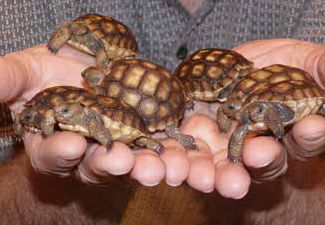
OUR STRATEGY: North American desert tortoises have seen their natural populations decimated by development, habitat destruction and fragmentation, and other human-caused threats including chemical and hormonal pollution, gradual global warming, invasive alien species, various illnesses due to introduced pathogens, such as the upper respiratory tract disease and a number of other human caused factors.
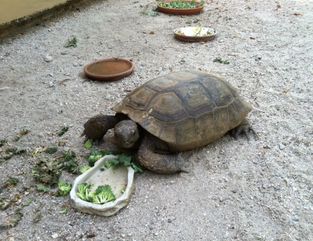
Background: The desert tortoise is one of four tortoise species found in North America. It can be found in four states - California, Nevada, Arizona, and Utah. Desert tortoises reach 8 to 15 inches in length and 4 to 6 inches in shell height. Adult tortoises can weigh between 8 and 15 pounds. A desert tortoise's lifespan is 60 to 80 years in the wild, 80 to 100 years in captivity. The first 5 years of their life are the hardest as their shells are still not completely hardened, making them more susceptible to predators. The desert tortoise does not become sexually mature until 13 to 20 years of age. Females lay one to ten eggs and zero to three clutches per year. Once tortoise reach maturity their rate of survival increases significantly.
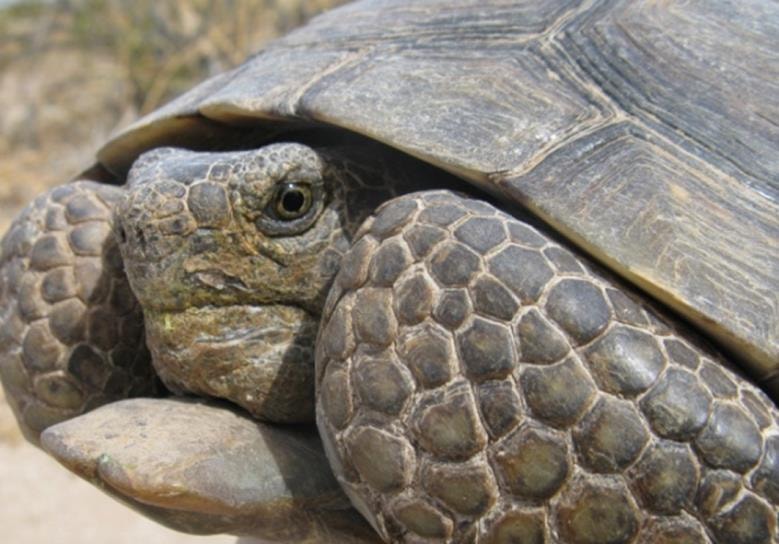
Tortoises have become well adapted to their harsh desert environment, possessing nails for digging and strong forearms and elephant-like hind limbs. Since desert climate is so extreme, the desert tortoise spends a majority of its life underground in burrows they dig or find already made. A tortoise will have multiple burrows throughout their home range. The average male desert tortoise has a home range averaging 200 acres, with females averaging half that amount. In a lifetime a tortoise can use over 1.5 square acres and can travel as much as 7 miles at a time. In the winter, tortoises enter a state of 'brumation'. Unlike hibernation, a tortoise in a state of brumation will leave its burrow if there is rainfall in the winter, but return quickly. They emerge from their burrows in early spring and stay active until fall. During this time the tortoises will mate and depending on food and water availability will lay eggs.
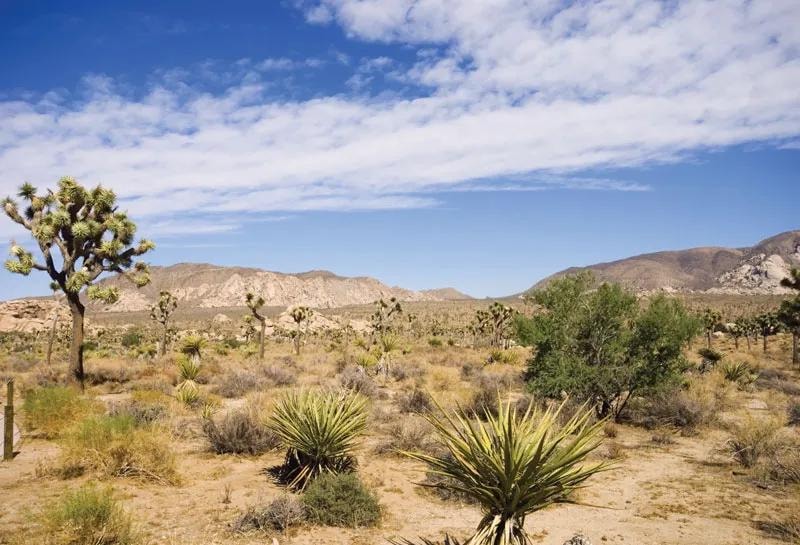
Their habitat can range, but typically Mojave Desert tortoises are found below 5500 feet in creosote brush-scrubs on gently sloping terrain. Desert tortoises are herbivores, feeding only on plant material. They eat a wide variety of grasses and annual flower plants. Tortoises are even able to eat dried plant material and still extract water from it. Tortoises have the ability to store water in their bodies for over one year, an adaptation well suited for the desert.
Recent research has proven genetic, physiological and behavioral differences between the Sonoran and Mojave population of desert tortoise leading to a split between the two species, the Mojave (Gopherus agassizii) and the Sonoran (Gopherus morafkai). While both populations struggle to survive, the Mojave population is recognized as threatened by the United States Fish and Wildlife.
Threats to the Desert Tortoise
The desert tortoise faces a number of threats in the wild. The first is the present or threatened destruction, modification or curtailment of the desert tortoise habitat by urbanization, fragmentation and degradation. These things can happen by construction of roads and highways, off-highway vehicle activity, poor grazing management, invasion of non-native species leading to increased wildfires, landfill and other waste disposal facilities and military operations. Over utilization for commercial, recreational, scientific and educational use including the deliberate maiming or killing of tortoises, collection for food or pets and for use in research is another threat to the tortoise. There is also factors of disease and predation. Upper respiratory tract disease is the number one disease killing desert tortoises. Ravens are the top predator of adult tortoises. Other predators include red-tail hawks, golden eagle, loggerhead shrikers, American kestrels, burrowing owls, greater roadrunners, kit foxes, mountain lions, ground squirrels, free-roaming dogs and fire ants. The lack of funding to enforce regulations is an additional factor. Lastly, the unauthorized release or escape of pet desert tortoises into the wild poses a serious threat.
Recovery Updates
The Mojave population of the desert tortoises has been listed as threatened since April 2, 1990. In June of 1994, the first recovery plan for the Mojave desert tortoise was published. It contained a detailed strategy to recover the Mojave population which would hopefully produce positive outcomes by year 2025. In 2003, the recovery plan was assessed by committee and it was noticed that while the 1994 recovery plan was adequate, revisions should be made with the collaboration from scientists, managers and stakeholders. In June 2011, a revised version of the recovery plan was released coming from this collaborative effort. In the near future, regional, inter-organizational Recovery Implementation Teams will be established to prioritize and coordinate the completion of the six major recovery actions: 1. Develop, support and build partnerships to facilitate recovery. 2. Protect existing populations and habitat, instituting habitat restoration when necessary. 3. Augment depleted population in a strategic manner. 4. Monitor progress towards recovery. 5. Conduct applied research and modeling in support of recovery efforts within a strategic framework. 6. Implement a formal adaptive management program through which information gained while implementing the above strategic elements is used to revise and improve the recovery plan and recommend management actions on a regular basis.
Conservation Efforts:
One of the main goals of the recovery plan is to focus on conservation efforts. Those efforts include a variety of different ways in which the desert tortoise population can be recovered. Conservation strategies range from improved grazing to land acquisition and habitat conservation plans to reducing raven populations. the desert tortoise is considered an umbrella species in the desert. It plays an important role in the balance of the desert, its burrows providing homes for other animals. It is important for us to conserve what is left of the desert tortoise habitat that is intact and restore what we can for use by desert tortoises and other desert wildlife. In addition to securing lands and habitat for conservation it is also important for us to connect functional habitat. Since we know that tortoises are generally solitary animals that need large areas in which to feed, it is important to make sure they are provided with the space to be successful. The desert is being used for such a variety of activities - mining, grazing, landfills, and renewable energy. All of these activities have an adverse effect on desert tortoises and need to be minimized. The push towards renewable energy has resulted in the loss of thousand of acres of critical desert tortoise habitat. Solar and wind projects have already claimed approximately 60,000 acres with the potential of 11,000 acres in the near future. It is important for us to explore and begin to use renewable energy as well as use what the desert has to offer, but it should be done in moderation and should be monitored so that they are not impacting the well-being of the desert tortoise and other desert animals. Excessive predation is a big factor in the decrease of desert tortoise populations. The main culprit is the raven (Corvus corvax). Ravens are intelligent animals and learn behaviors from their families. Because of this, it is extremely dangerous for hatching desert tortoise when a community of ravens learns to prey on them. To combat this issue, it is the goal of the recovery plan to reduce the raven population by: * Reducing trash availability to ravens in landfills * Removing illegal dumps * Adding fencing along highways to reduce road kills * Removing or modifying nesting and roost sites so that they are not near nests, and * Identifying and removing ravens that have preyed upon or attempted to prey upon desert tortoises In addition to ravens, pet desert tortoises are also a danger to wild tortoises. Pet tortoises are exposed to different diseases that a wild desert tortoise. The most common of these diseases is upper respiratory tract infection. Untreated this infection can cause death. Upper respiratory tract infection is not always easy to detect and therefore a pet desert tortoise that can look healthy and is not showing any signs can still be carrying the disease. This is why it is important that pet tortoises of any age are not released into the wild. It has been shown that an educated public is more likely to be aware of consequences and more willing to take responsibility for their actions. Therefore, the recovery plan calls for an establishment and continuation of environmental education programs. Southern California has its /desert Tortoise Information and Youth Education Program which is run from The Living Desert. The program focuses on desert users to try and change learned behavior and reduce conflict. It is also important to educate the future generations about the importance of preserving not only the desert tortoise, but also the desert, for one cannot survive without the other
Source: Kyle Pong, Desert Tortoise Conservation Outreach Coordinator; The Living Desert
Our Affiliations
Help Our Cause
Your donation directly supports desert tortoise conservation, education, and the creation of the Desert Tortoise Awareness Center.
The Tortoises We Protect